
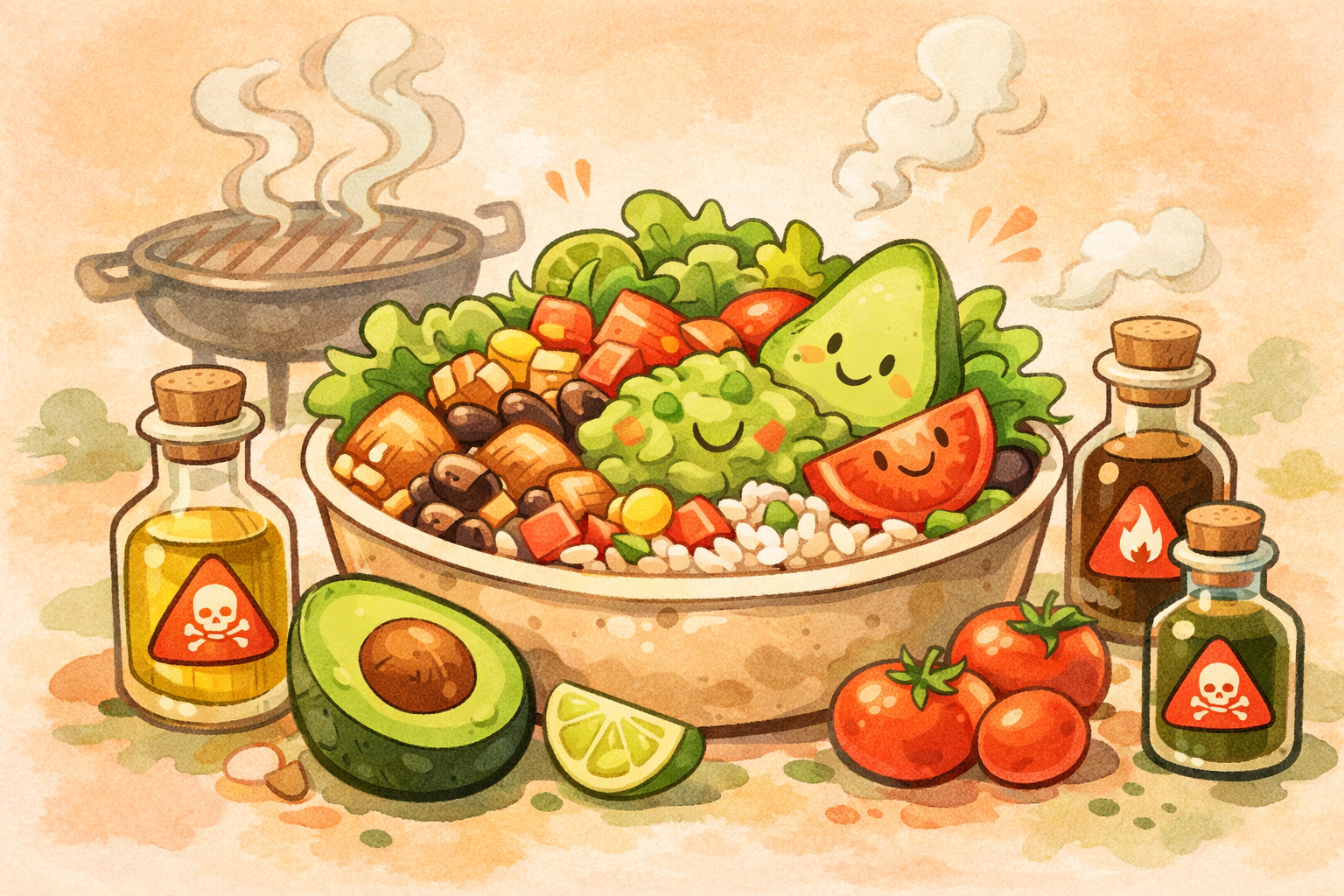
Chipotle's Oil Problem: What They're Not Telling You About Their 'Fresh' Ingredients
Chipotle built its reputation on "food with integrity," promising fresh ingredients and transparent sourcing. But there's one ingredient they don't advertise on their feel-good marketing materials: the industrial seed oils lurking in many of their menu items.
If you're trying to avoid inflammatory seed oils for better health, ordering at Chipotle requires careful navigation. Let's break down exactly what oils they use, where they hide, and how you can still enjoy a meal there without compromising your health goals.
The Unfortunate Truth: Yes, Chipotle Uses Seed Oils
Despite their commitment to quality ingredients, Chipotle relies heavily on rice bran oil and sunflower oil throughout their menu. These industrial seed oils undergo extensive processing, including high heat, chemical solvents, and deodorization—far from the "fresh" image Chipotle cultivates.
🛡️ Trying to avoid seed oils? Seed Oil Scout has you covered.
2M+ downloads. 23K+ five-star reviews. Verified restaurant and grocery data so you always know what you're eating.
Rice bran oil, extracted from the hard outer layer of rice, requires hexane (a petroleum-based solvent) for extraction. The oil then undergoes bleaching and deodorizing at temperatures exceeding 400°F. Sunflower oil follows a similar industrial process, stripping away any natural antioxidants while concentrating unstable polyunsaturated fatty acids.
These oils are particularly problematic when heated repeatedly in restaurant settings. Studies show that heating polyunsaturated oils creates harmful compounds including aldehydes and trans fats—even in oils marketed as "trans-fat free."
Where Seed Oils Hide on Chipotle's Menu
The seed oil situation at Chipotle is more complex than a simple yes or no. Here's where you'll find these inflammatory oils:
Rice bran oil appears in:
- The rice (both white and brown varieties)
- Fajita vegetables
- Chips (fried in sunflower oil)
- Crispy corn tortillas
Surprisingly seed oil-free items include:
- All meats (seasoned with spices only)
- Beans (both black and pinto)
- Fresh salsas
- Guacamole
- Cheese
- Sour cream
- Lettuce
The tortillas present an interesting case. While the soft flour tortillas contain soybean oil, the amount is relatively minimal compared to items cooked in oil. However, for those strictly avoiding all seed oils, even these small amounts matter.
The Health Impact of Chipotle's Oil Choices
Industrial seed oils weren't part of the human diet until the early 1900s. Today, Americans consume roughly 20% of their calories from these oils—a 1000-fold increase from pre-industrial times. This dramatic shift correlates with rising rates of chronic inflammation, metabolic dysfunction, and cardiovascular disease.
Rice bran oil contains approximately 32% omega-6 linoleic acid, while sunflower oil can contain up to 70%. When consumed in excess, these omega-6 fatty acids promote inflammation by competing with anti-inflammatory omega-3s for incorporation into cell membranes.
Research from the National Institutes of Health links excessive omega-6 consumption to increased inflammatory markers, insulin resistance, and obesity. The problem intensifies when these oils are repeatedly heated, as happens in restaurant fryers.
Smart Ordering Strategies for Seed Oil Avoiders
You don't have to give up Chipotle entirely. With strategic ordering, you can create satisfying meals while minimizing seed oil exposure:
Build a bowl without the rice: Start with lettuce as your base instead. You'll save calories while avoiding the rice bran oil.
Skip the fajita veggies: While vegetables seem healthy, Chipotle's are sautéed in rice bran oil. Opt for fresh salsa to add vegetable nutrients without the inflammatory oils.
Load up on protein: All of Chipotle's meats are cooked without added oils. Double protein provides satiety without seed oil exposure.
Embrace the guacamole: Made from avocados, lime, cilantro, and salt, guac provides healthy monounsaturated fats without any industrial oils.
Consider a salad: Building your meal on lettuce eliminates the oils in rice while adding nutrients and fiber.
The Bigger Picture: Why Restaurants Choose Seed Oils
Chipotle isn't uniquely problematic—most restaurants rely on industrial seed oils for economic reasons. These oils cost significantly less than traditional fats like butter, tallow, or olive oil. They also have longer shelf lives and higher smoke points, making them practical for high-volume cooking.
A gallon of rice bran oil costs restaurants roughly $8-12, while extra virgin olive oil runs $30-50 per gallon. For a chain serving millions of customers daily, these cost differences translate to millions in profits.
Additionally, seed oils provide the "neutral" flavor many consumers expect. Traditional fats like beef tallow or lard, while healthier, impart distinct flavors that might alienate customers accustomed to bland, processed foods.
Making Peace with Imperfection
Avoiding seed oils entirely while eating out requires significant effort and often limits social experiences. The goal isn't perfection but rather informed decision-making. If you eat at Chipotle occasionally and avoid the highest seed oil items, the impact on your overall health remains minimal.
However, if Chipotle is your go-to lunch spot several times per week, those seed oils add up quickly. Regular consumption of foods cooked in industrial oils contributes to chronic inflammation and metabolic dysfunction over time.
Consider the 80/20 principle: if you avoid seed oils 80% of the time through careful home cooking and smart restaurant choices, occasional exposure won't derail your health goals.
Take Control of Your Restaurant Choices
Knowledge is power when navigating restaurant menus. Understanding which items contain seed oils empowers you to make choices aligned with your health values—whether that means strict avoidance or strategic moderation.
Want to make seed oil-free dining easier? The Seed Oil Scout app instantly identifies menu items containing inflammatory oils at thousands of restaurants. Simply search any restaurant to see which dishes are safe and which to avoid. Download Seed Oil Scout today and take the guesswork out of healthy dining—because you shouldn't need a chemistry degree to order lunch.