
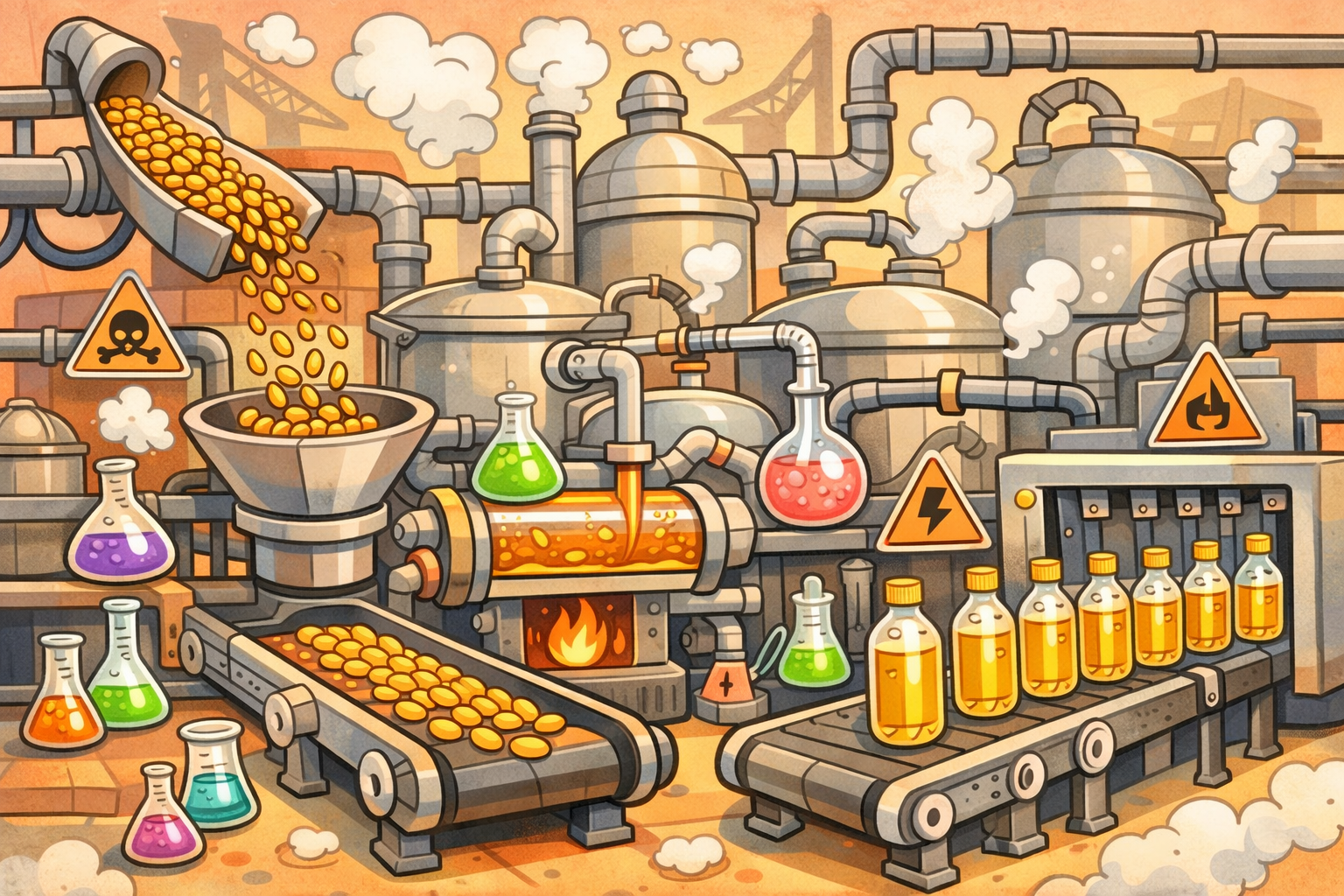
How Seed Oils Are Made: The Industrial Process That Changes Everything
The Seeds That Started It All
Before the 1900s, cooking with oils from cotton seeds, soybeans, or corn kernels would have seemed absurd. These seeds were livestock feed, industrial materials, or simply agricultural waste. Today, they dominate grocery store shelves and restaurant kitchens as "vegetable oils"—a marketing term that masks their true industrial origins.
🛡️ Trying to avoid seed oils? Seed Oil Scout has you covered.
2M+ downloads. 23K+ five-star reviews. Verified restaurant and grocery data so you always know what you're eating.
The transformation of these seeds into clear, flavorless oils requires an intensive chemical process that would shock most consumers. Unlike traditional fats like butter or olive oil, which humans have consumed for millennia, seed oils are a modern invention made possible only through industrial chemistry.
Step 1: Crushing and Heating Under Extreme Conditions
The journey from seed to oil begins with mechanical crushing. Industrial facilities heat seeds to temperatures between 180-220°F (82-104°C) before feeding them through massive steel rollers. This heating process, necessary to maximize oil extraction, immediately begins breaking down the delicate polyunsaturated fatty acids (PUFAs) that make up 50-75% of most seed oils.
Research published in the Journal of Food Science shows that heating polyunsaturated fats above 180°F initiates lipid peroxidation—essentially, the oils begin going rancid before they even leave the crushing facility. The resulting paste, now partially oxidized, moves to the next phase: chemical extraction.
The Hexane Bath: Chemical Extraction at Its Core
Here's where things get truly industrial. To extract every possible drop of oil, processors bathe the crushed seed paste in hexane—a petroleum-derived solvent that's also used in gasoline production. The seeds soak in this chemical bath at approximately 150°F (65°C) for up to an hour.
Hexane is remarkably efficient, extracting up to 98% of available oil compared to just 70% through mechanical pressing alone. But efficiency comes at a cost. The FDA permits hexane residues up to 30 parts per million in finished oils, though studies have detected levels exceeding this limit in commercially available products.
After extraction, processors must remove the hexane through evaporation—another high-heat process reaching 212°F (100°C) or higher. Each heating cycle further degrades the oil's molecular structure, creating harmful compounds including aldehydes, ketones, and trans fats.
Degumming, Neutralization, and the Chemical Cascade
Raw seed oil emerging from hexane extraction is far from the clear, neutral-tasting product on store shelves. It's dark, smelly, and filled with compounds that processors call "impurities"—including phospholipids, free fatty acids, and natural antioxidants that actually protect the oil from rancidity.
The degumming process adds phosphoric acid or citric acid to remove phospholipids. Next comes neutralization, where processors add sodium hydroxide (lye) to eliminate free fatty acids. These chemicals don't just remove unwanted compounds—they fundamentally alter the oil's chemistry.
A 2020 analysis in Food Chemistry found that chemical refining removes up to 90% of natural vitamin E and other antioxidants from seed oils. Without these protective compounds, the oils become even more susceptible to oxidation and rancidity.
Bleaching and Deodorizing: The Final Transformation
Even after degumming and neutralization, seed oils retain a dark color and strong odor—clear signs of their industrial processing. Enter bleaching clay, which absorbs pigments and remaining impurities. This isn't the gentle process the name suggests; oils are heated to 180-220°F (82-104°C) and mixed with acid-activated clay minerals.
The final step—deodorization—is perhaps the most damaging. Processors heat the oil to an astounding 400-500°F (204-260°C) under high pressure to remove any remaining odors and flavors. At these temperatures, polyunsaturated fatty acids don't just oxidize—they transform into entirely new compounds.
Research from the European Journal of Lipid Science and Technology identified over 20 different toxic aldehydes formed during high-temperature deodorization, including 4-hydroxynonenal (4-HNE), a compound linked to Alzheimer's disease, liver damage, and cardiovascular disease.
The Trans Fat Problem Nobody Talks About
While the FDA banned artificial trans fats in 2015, few people realize that seed oil processing creates its own trans fats. The high-heat deodorization process converts up to 3.6% of polyunsaturated fats into trans configurations—levels that researchers have shown significantly impact cardiovascular health.
Unlike the trans fats in partially hydrogenated oils, these processing-induced trans fats don't appear on nutrition labels. They're formed not through intentional hydrogenation but as an unavoidable consequence of extreme processing temperatures.
What This Means for Your Health
The industrial processing of seed oils creates three major problems:
1. Oxidation Products: The repeated high-heat processing creates lipid peroxides, aldehydes, and other oxidation products that trigger inflammation when consumed. A landmark study in BMJ found that replacing saturated fats with high-linoleic seed oils increased mortality by 62%.
2. Nutrient Depletion: The aggressive chemical processing strips away fat-soluble vitamins and natural antioxidants, leaving behind empty calories devoid of nutritional value.
3. Chemical Residues: Despite industry claims of safety, hexane residues, bleaching compounds, and processing chemicals remain in finished products at levels that accumulate with regular consumption.
Traditional Fats vs. Industrial Seed Oils
Compare seed oil production to traditional fats: butter requires simple churning of cream; olive oil needs only crushing and centrifugation; coconut oil involves pressing and minimal heat. These foods have nourished humans for thousands of years without industrial intervention.
The human body evolved consuming fats with specific fatty acid profiles—primarily saturated and monounsaturated fats with small amounts of polyunsaturated fats from whole foods. Seed oils flip this ratio, delivering unprecedented amounts of omega-6 fatty acids in a highly processed, oxidized form.
Making Informed Choices in a Seed Oil World
Understanding how seed oils are made empowers you to make informed decisions about what you eat. When you see "vegetable oil," "soybean oil," or "canola oil" on an ingredient list, you're not just seeing a simple cooking fat—you're seeing the end product of an intensive industrial process involving petroleum solvents, caustic chemicals, and extreme temperatures.
Restaurants rely heavily on seed oils because they're cheap and have a long shelf life—not because they're healthy. Finding restaurants that cook with traditional fats like butter, olive oil, or animal fats can feel impossible without inside knowledge.
That's where Seed Oil Scout comes in. Our app instantly identifies restaurants in your area that avoid seed oils, making it easy to eat out without compromising your health. With crowdsourced reviews and verified restaurant data, you can finally enjoy dining out while avoiding industrial seed oils. Download Seed Oil Scout today and join thousands of health-conscious diners taking control of their food choices.