
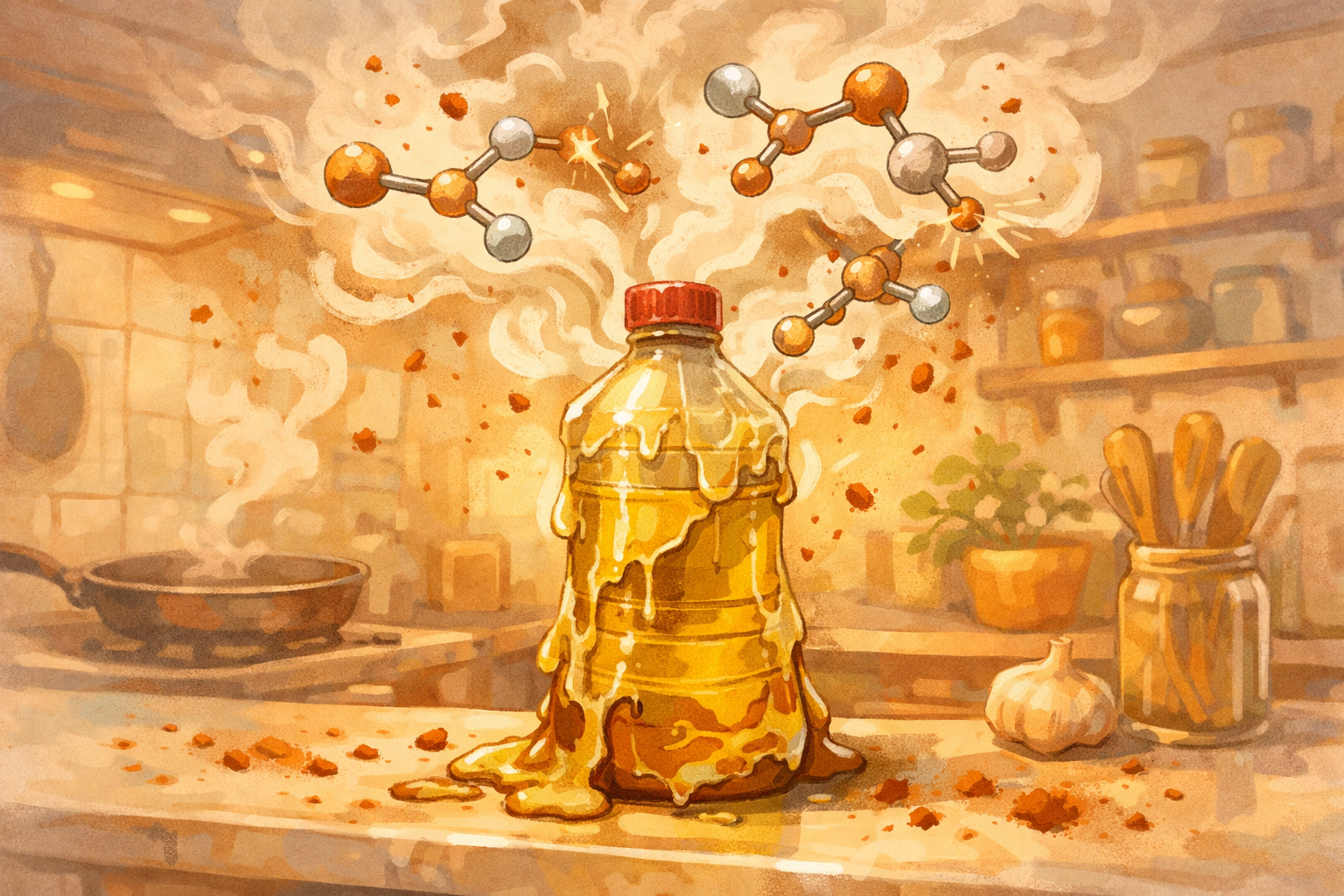
Why Seed Oils Go Bad: The Hidden Danger of Oxidation in Your Kitchen
That bottle of vegetable oil sitting in your pantry might look harmless, but there's an invisible chemical reaction happening inside that transforms these oils into something far more concerning. The process is called oxidation, and it's the primary reason seed oils pose such a significant threat to your health.
The Chemistry of Disaster: Understanding Polyunsaturated Fats
Seed oils like soybean, corn, sunflower, and canola oil are predominantly composed of polyunsaturated fatty acids (PUFAs). These molecules contain multiple double bonds in their carbon chains, making them chemically unstable and highly reactive. Think of these double bonds as weak points in a chain — the more you have, the easier the chain breaks.
🛡️ Trying to avoid seed oils? Seed Oil Scout has you covered.
2M+ downloads. 23K+ five-star reviews. Verified restaurant and grocery data so you always know what you're eating.
When exposed to heat, light, or oxygen, these vulnerable double bonds react and break down, creating a cascade of harmful compounds. This isn't just theoretical chemistry — it's happening right now in kitchens and restaurants across the country.
Compare this to saturated fats found in butter, coconut oil, or tallow. These fats have no double bonds, making them incredibly stable and resistant to oxidation. It's like comparing a steel chain to one made of paper clips — one can withstand stress while the other falls apart at the slightest provocation.
The Oxidation Process: From Fresh Oil to Toxic Soup
Oxidation begins the moment seed oils are extracted from their source. The industrial processing itself — involving high heat, pressure, and chemical solvents — kickstarts the degradation process before the oil even reaches the bottle.
Here's what happens during oxidation:
- Primary oxidation: Oxygen molecules attack the double bonds, creating hydroperoxides
- Secondary oxidation: These unstable compounds break down into aldehydes, ketones, and other reactive molecules
- Advanced oxidation: Complex polymers form, creating the thick, sticky residue you might notice in old oil
Research from the University of Minnesota found that heating soybean oil to typical cooking temperatures (180°C/356°F) for just 8 hours created over 20 different toxic aldehydes, including known carcinogens like acrolein and 4-hydroxynonenal (4-HNE).
The Smell of Danger: Recognizing Rancid Oils
Your nose knows when oil has gone bad. That paint-like, fishy, or metallic smell? That's the scent of aldehydes and other oxidation products. But here's the disturbing part: significant oxidation occurs long before you can smell it.
A 2019 study published in the Journal of Food Science found that by the time consumers could detect rancidity by smell, the oil had already accumulated dangerous levels of oxidation products — up to 10 times the recommended safety threshold.
Restaurant fryers present an even bigger problem. Many establishments use the same oil for days or even weeks, repeatedly heating it to high temperatures. Each heating cycle accelerates oxidation exponentially. One analysis found that oil used in commercial fryers for just three days contained aldehyde levels 100 times higher than fresh oil.
The Body's Burden: What Oxidized Oils Do Inside You
When you consume oxidized oils, these reactive compounds don't simply pass through your system. They interact with proteins, DNA, and cellular membranes, triggering inflammation and oxidative stress throughout your body.
Dr. Martin Grootveld from De Montfort University Leicester has extensively studied aldehyde formation in cooking oils. His research shows that a typical serving of food cooked in repeatedly heated seed oil can contain 10-50 times more toxic aldehydes than the daily safe limit set by the World Health Organization.
These compounds have been linked to:
- Accelerated aging and cellular damage
- Increased inflammation markers
- Disrupted hormone production
- Impaired liver function
- Elevated risk of cardiovascular disease
The Storage Nightmare: Why Seed Oils Can't Win
Even if you store seed oils perfectly — in a dark, cool place in an airtight container — oxidation still occurs. The high PUFA content makes degradation inevitable; you can only slow it down, not stop it.
Consider this: olive oil, which contains far fewer polyunsaturated fats than seed oils, has a recommended shelf life of 18-24 months when stored properly. Seed oils, despite having similar labeled expiration dates, begin accumulating harmful compounds much faster due to their unstable molecular structure.
A 2020 analysis of commercially available vegetable oils found that 68% already showed signs of oxidation when tested fresh from the store. By the time these oils reach your kitchen and sit in your pantry for a few months, the oxidation products have multiplied significantly.
Restaurant Reality: Where Oxidation Runs Wild
Restaurants face unique challenges that make seed oil oxidation even worse. High-volume cooking means oils are heated repeatedly, often held at high temperatures for hours, and exposed to food particles that accelerate breakdown.
Fast food establishments are particularly problematic. A study analyzing oil from major chain restaurants found aldehyde levels that exceeded safety thresholds by up to 200 times. That seemingly innocent order of fries might be delivering a concentrated dose of oxidized lipids straight to your system.
Even "healthier" restaurants that advertise using "fresh" oil daily are still subjecting seed oils to extreme temperatures that cause rapid oxidation. The damage happens in minutes, not days.
Breaking Free: Your Action Plan
Understanding oxidation empowers you to make better choices. Here's what you can do:
- Choose restaurants that cook with stable fats like butter, ghee, or coconut oil
- Ask how often fryer oil is changed when dining out
- Avoid fried foods at establishments that use seed oils
- Look for restaurants that prioritize traditional cooking fats
Knowledge is power, but convenience is king. That's where technology becomes your ally in avoiding oxidized seed oils. The Seed Oil Scout app takes the guesswork out of dining decisions by mapping seed oil-free restaurants in your area and providing real-time information about cooking oils used at thousands of establishments.
Don't let another meal compromise your health with oxidized oils. Download Seed Oil Scout today and join thousands of health-conscious diners who've taken control of their food choices. Your body will thank you for avoiding the oxidation trap that's been hiding in plain sight.